



Please visit our Open House at 1508 Cedar Springs Place in Delta. See details here
Welcome to this stunning 3,606 sq. ft. golf course home at Tsawwassen Springs, offering 5 bedrooms, a den, games room, and 6 bathrooms. The main floor features a primary suite, vaulted great room with gas fireplace, gourmet kitchen with butler's pantry, and multi-fold doors opening to a covered patio with gas fire pit, perfect for entertaining. Upstairs offers a second primary suite with walk-in closet and ensuite, three additional bedrooms, a versatile games room, and a view deck overlooking the golf course. With a two-car garage, ample storage, and thoughtful design throughout, this home blends elegance and function in one of South Delta's most desirable communities. Book your private viewing today and experience golf course living at its finest.
Please visit our Open House at 1508 Cedar Springs Place in Delta. See details here
Open House on Saturday, October 10, 2026 2:00PM - 4:00PM
Welcome to this stunning 3,606 sq. ft. golf course home at Tsawwassen Springs, offering 5 bedrooms, a den, games room, and 6 bathrooms. The main floor features a primary suite, vaulted great room with gas fireplace, gourmet kitchen with butler's pantry, and multi-fold doors opening to a covered patio with gas fire pit, perfect for entertaining. Upstairs offers a second primary suite with walk-in closet and ensuite, three additional bedrooms, a versatile games room, and a view deck overlooking the golf course. With a two-car garage, ample storage, and thoughtful design throughout, this home blends elegance and function in one of South Delta's most desirable communities. Book your private viewing today and experience golf course living at its finest.


Home sales registered on the MLS® in Metro Vancouver* declined 8.4 per cent relative to September last year, weighed down by the apartment segment.
The Greater Vancouver REALTORS® (GVR) reports that residential sales in the region totalled 1,717 in September 2026, an 8.4 per cent decrease from the 1,875 sales recorded in September 2025. This was 25 per cent below the 10-year seasonal average (2,289).
“While sales were down about eight per cent overall in September, this figure hides the fact the weakness is contained to the sizeable apartment segment, which typically accounted for half of sales in any given month in recent years,” said Andrew Lis, GVR chief economist and vice-president data analytics. “By contrast, sales of attached and detached homes finished slightly up from last September, consistent with our view that end-users are primarily driving the market, as investor-driven demand awaits more favourable market conditions.”
There were 5,852 detached, attached and apartment properties newly listed for sale on the Multiple Listing Service® (MLS®) in Metro Vancouver in September 2026. This represents a 10.3 per cent decrease compared to the 6,527 properties listed in September 2025. This was 5.7 per cent above the 10-year seasonal average (5,537).
The total number of properties currently listed for sale on the MLS® system in Metro Vancouver is 16,394, a four per cent decrease compared to September 2025 (17,079). This is 24.3 per cent above the 10-year seasonal average (13,186).
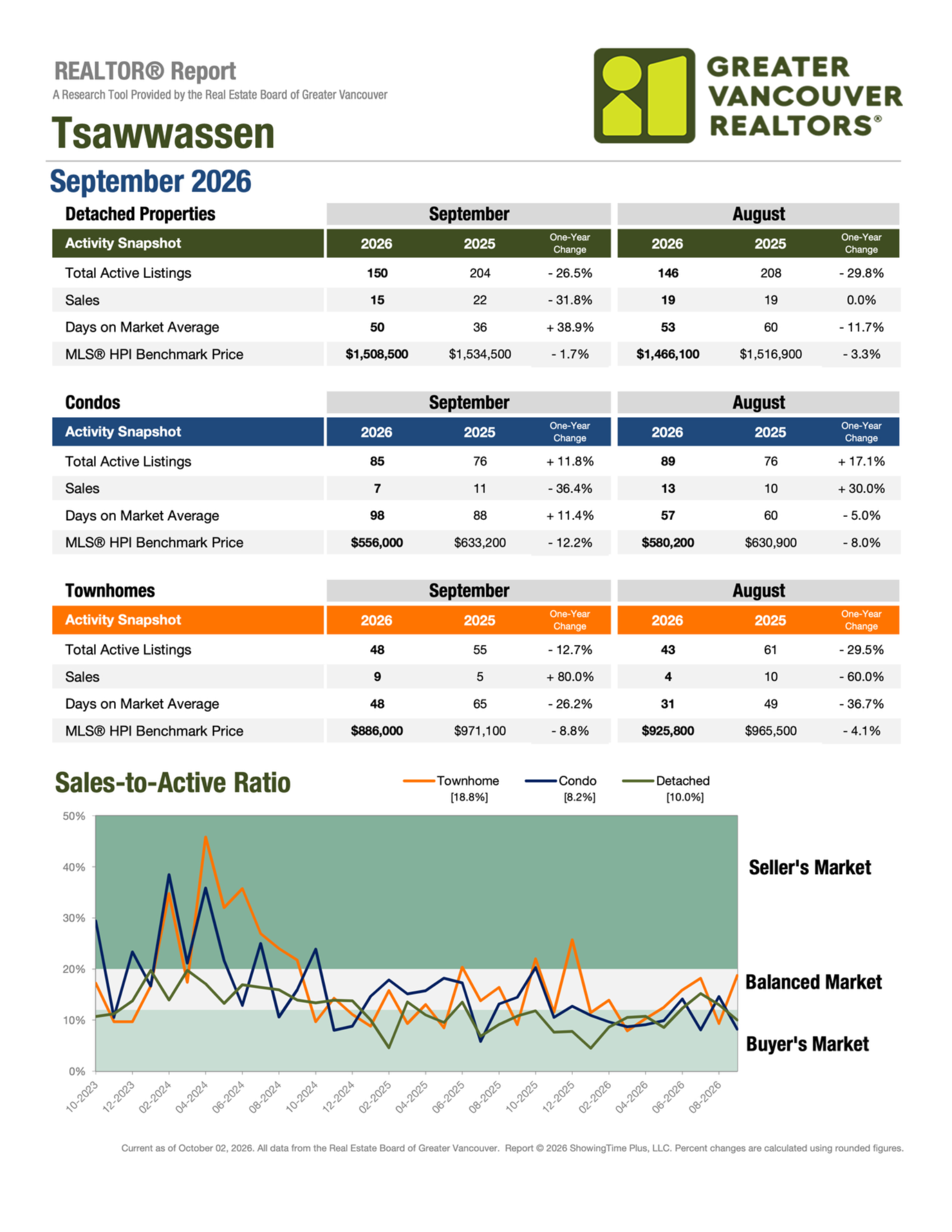
Across all detached, attached and apartment property types, the sales-to-active listings ratio for September 2026 is 10.9 per cent. By property type, the ratio is 9.7 per cent for detached homes, 12.2 per cent for attached, and 11.4 per cent for apartments.
Analysis of the historical data suggests downward pressure on home prices occurs when the ratio dips below 12 per cent for a sustained period, while home prices often experience upward pressure when it surpasses 20 per cent over several months.
“The combination of slow sales and inventory trending lower has kept home prices from declining too swiftly, with the composite price index drifting down 0.5 percent month –over-month,” Lis said. “While small month-over-month changes may not appear significant individually, the cumulative effect of many small changes has become more pronounced over time, with all market segments now showing price declines of about three per cent since the start of the year.”
The MLS® Home Price Index composite benchmark price for all residential properties in Metro Vancouver is currently $1,075,900. This represents a 5.5 per cent decrease over September 2025 and a 0.6 per cent decrease compared to August 2026.
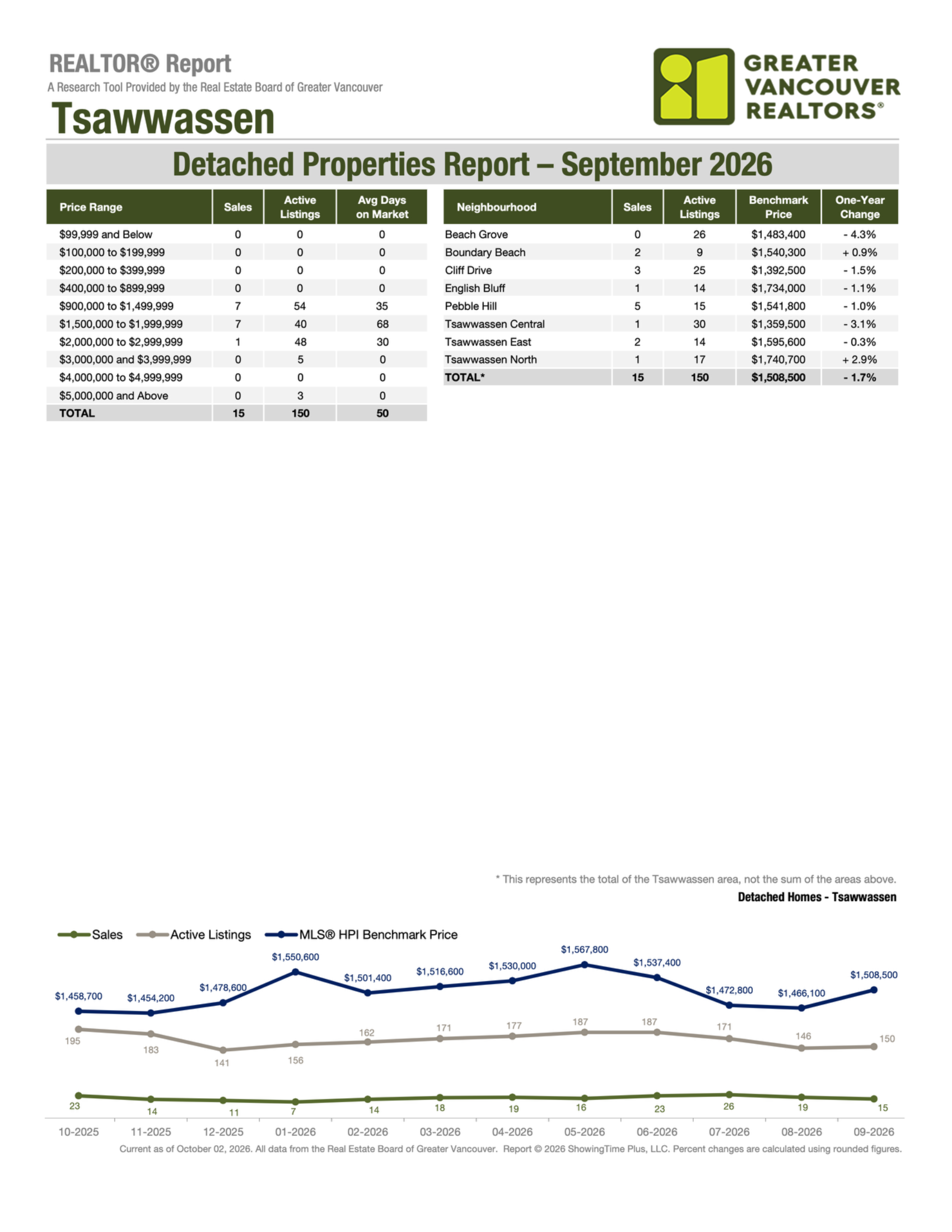
Sales of detached homes in September 2026 reached 575, a 4.2 per cent increase from the 552 detached sales recorded in September 2025. The benchmark price for a detached home is $1,784,700. This represents a 7.3 per cent decrease from September 2025 and a 0.8 per cent decrease compared to August 2026.
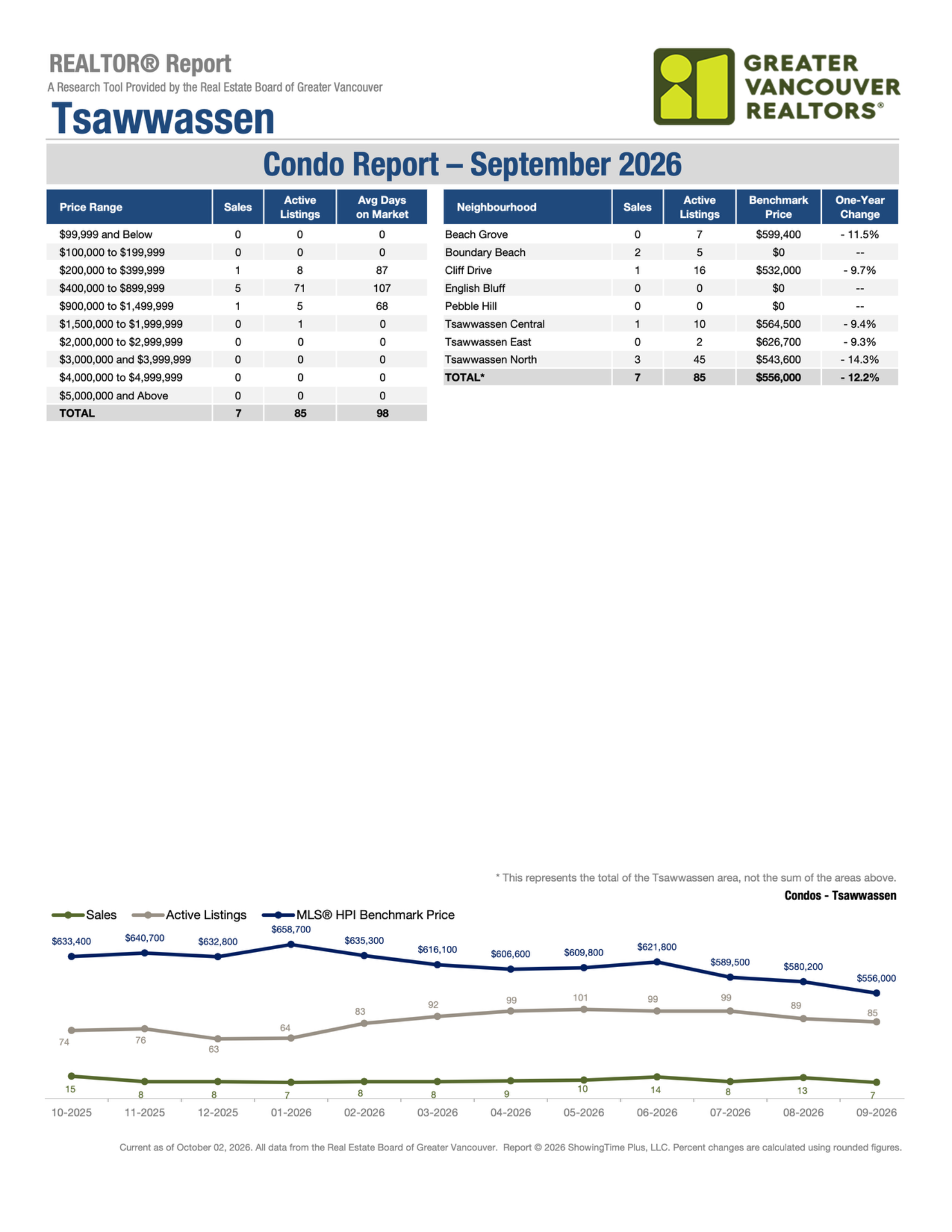
Sales of apartment homes reached 777 in September 2026, a 18.6 per cent decrease compared to the 954 sales in September 2025. The benchmark price of an apartment home is $682,500. This represents a 6.2 per cent decrease from September 2025 and a 0.5 per cent decrease compared to August 2026.
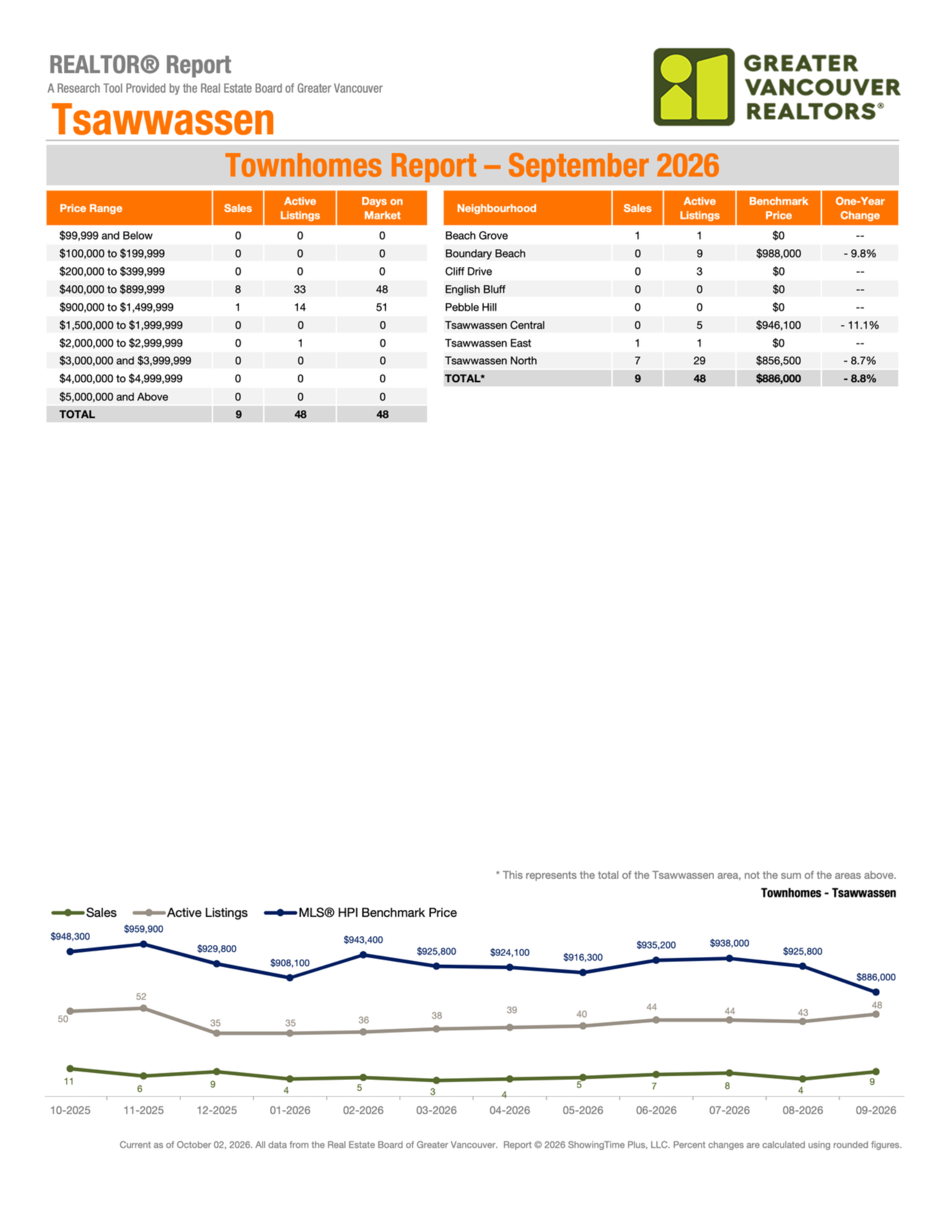
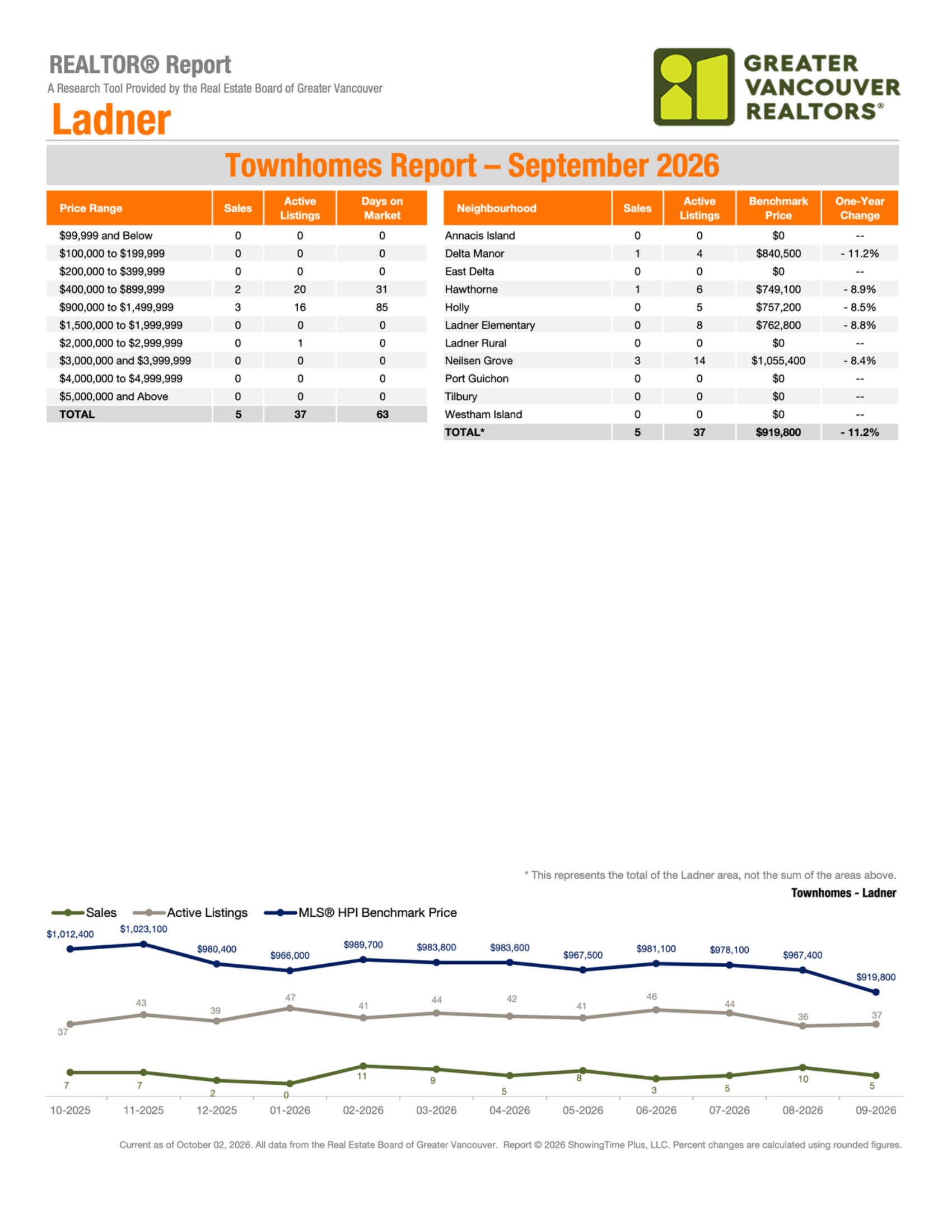
Attached home sales in September 2026 totalled 358, a 0.6 per cent increase compared to the 356 sales in September 2025. The benchmark price of a townhouse is $1,016,700. This represents a 4.7 per cent decrease from September 2025 and a 1.2 per cent decrease compared to August 2026.
Click here for more information.
Call Sarah Toigo & Associates today to discuss how the market impacts you.
I have listed a new property at 5090 Springs Boulevard in Delta. See details here
This charming 2-bedroom, 2.5-bathroom homes is the only rancher on the golf course at Tsawwassen Springs, offering a perfect blend of style, comfort, and luxury. The well-designed kitchen features timeless white shaker cabinetry and stainless steel appliances, complemented by stunning granite countertops.The well appointed, spacious primary suite, complete with a spa-like ensuite bathroom, highlighted by a large, free-standing soaking tub for ultimate relaxation. A versatile den adds flexible space for a home office.Conveniently located near all amenities, this home is the epitome of resort-style living at its finest. Don’t miss the opportunity to experience comfort and elegance in one perfect package!
Please visit our Open House at 5116 Cedar Springs Drive in Delta. See details here
Open House on Sunday, September 27, 2026 2:00PM - 4:00PM
Discover elevated golf course living at Tsawwassen Springs in this stunning 1,981 sq ft home designed with comfort and style in mind. The spacious open-concept floor plan features expansive windows, and seamless indoor-outdoor living. A chef-inspired kitchen anchors the home with premium finishes, generous cabinetry, and an oversized island ideal for entertaining. The luxurious primary suite offers a spa-like ensuite and walk-in closet, while the second bedroom provides privacy for guests. A dedicated den and separate flex room create the perfect spaces for a home office, media room, or gym. Complete with 2 full bathrooms, 2 powder rooms, and beautifully finished living areas throughout, this home offers sophisticated, low-maintenance living in one of Tsawwassen’s premier golf communities.

Expert Guidance
REALTORS® are like a trusty GPS in the world of real estate. They know the ins and outs of the real estate market and can help guide you through the entire process, explaining everything at every stage.
Finding the Right Home
If you’re a homebuyer, REALTORS® can help you find homes that match your needs and budget. They can access databases with all available listings and filter through them to help find those that match your criteria, helping save you time and effort.
Negotiating Skills
REALTORS® are skilled at negotiating deals effectively.
Navigating Real Estate Documents
Real estate involves lots of paperwork, disclosure forms, and complex contracts, which can be overwhelming. A REALTOR® brings knowledge and expertise in efficiently handling forms and contracts, helping to ensure everything is done correctly and legally.
Market Knowledge
REALTORS® know what’s happening in your local real estate market, understand if it’s leaning toward a buyer or seller market, and can identify trends. REALTORS® have their finger on the pulse and can offer advice accordingly.
Protecting Your Interests
REALTORS® have a legal duty to prioritize and protect your interests. Responding diligently to unforeseen challenges, they help you navigate complexities during the buying and selling process.
Closing the Deal
REALTORS® are committed to helping you realize your real estate aspirations. They handle final negotiations and all the details leading up to closing. They aim for you to have a smooth and successful experience.
Call Sarah Toigo & Associates today to handle your real estate needs with confidence.

The MLS® Housing Price Index (HPI) is a measure of real estate prices that provides a clearer picture of market trends over traditional tools such as raw average or median prices.
The raw average price is obtained by dividing the total dollar volume of sales by the number of sales.
To obtain the median price, all of the sales prices are arrayed in ascending order, and the middle price is taken. In the case of an even number of sales, the median is the highest price in the lower half of the group. If there is an odd number of sales, the midpoint sale is taken as the median.
The MLS® HPI is modelled after the Consumer Price Index, which measures the rate of price change for a basket of goods and services. A basket is a combination of goods and services that Canadians buy most such as food, clothing, transportation, etc.
Instead of measuring goods and services, the MLS® HPI measures the rate at which housing prices change over time taking into account numerous features about the types of homes sold.
Before the original HPI was introduced in 1996, REALTORS® and the public relied on monthly raw average price statistics to understand trends in housing prices.
Raw averages, however, can be very misleading since the quantity and quality of the properties sold in any given area change over time for any number of reasons. As a result, average prices can fluctuate dramatically, making the housing market appear unstable.
To demonstrate this point, let’s look a couple of examples of how average prices are affected by various changes in the composition of sales.
Example 1: How raw averages are affected by the composition of sales
| Year 1 ($) | Year 2 ($) |
|---|---|
| 1. 139,000 | 1. 139,000 |
| 2. 145,000 | 2. 145,000 |
| 3. 230,000 | 3. 230,000 |
| 4. 265,000 | 4. 265,000 |
| 5. 290,000 average | 5. 290,000 median |
| 6. 320,000 | 6. 320,000 |
| 7. 365,000 | 7. 365,000 |
| 8. 425,000 | 8. *545,000 |
| 9. 480,000 | 9. *580,000 |
| Total $2,659,000 ÷ 9 sales = $295,444, which is the raw average | Total $2,879,000 ÷ 9 sales = $319,888, which is the raw average *price change from Year 1 |
In this example, the raw average price increased by 7.7 percent while the median price stayed the same. This shows that the composition of sales at either end of the price spectrum affect the raw average but can leave the median price unchanged.
Example 2: How median prices are affected by price changes
| Year 1 ($) | Year 2 ($) |
|---|---|
| 1. 139,000 | 1. 139,000 |
| 2. 145,000 | 2. 145,000 |
| 3. 230,000 | 3. 230,000 |
| 4. 265,000 | 4. *290,000 |
| 5. 290,000 median | 5. *320,000 median |
| 6. 320,000 | 6. *335,000 |
| 7. 365,000 | 7. *395,000 |
| 8. 425,000 | 8. *400,000 |
| 9. 480,000 | 9. *405,000 |
| Total $2,659,000 ÷ 9 sales = $295,444, which is the raw average | Total $2,659,000 ÷ 9 sales = $295,444, which is the raw average *price change from Year 1 |
In this example, the raw average stayed the same while the median average increased by 9.4 percent. This shows that the composition of sales in the mid-range of the price spectrum can affect the median price, but can leave the raw average unchanged.
Neither of these price measurements take into account the changes in buying patterns, nor important distinguishing characteristics of the homes sold. In year one, luxury homes in the region may be more popular and sell more frequently; the following year, more modestly priced homes may be popular.
Both methods of price tracking can have the effect of over- or under-estimating the market price.
The MLS® HPI is a more stable price indicator than raw average or median prices, because it tracks changes of "typical" homes, and excludes the extreme high-end and low-end properties.
Typical homes are defined by various quantitative property attributes (e.g., above ground living area in square feet) and qualitative features (e.g., proximity to shopping, schools, transportation, hospitals etc.). The MLS® HPI uses these features to estimate a more accurate price of the “typical” home in Greater Vancouver, based on how these features impacted the value of similar homes which sold recently.
These features together become the "benchmark" house, townhouse or apartment in a given area. A benchmark property is designed to represent a typical residential property in a specific MLS® HPI housing market, such as Richmond or North Vancouver.
For example, perhaps the basket of features for a typical home in a given community are defined as being a 10-year-old, 3-bedroom house without a panoramic or ocean view on a 7,200 sq. ft. lot, with 8 rooms, 2 bathrooms, a fireplace, a 1-car garage and is close to schools. A benchmark price for this home can be created from the individual dollar values ascribed to each of these features, based on recent data of similar properties that have sold.
More information about the MLS® HPI can be found at the following link to the Canadian Real Estate Association (CREA):
CREA | MLS® Home Price Index (HPI)
Note: The MLS® HPI offers only a benchmark in which to track price trends and consumers should be careful not to misinterpret index figures as actual prices. Benchmark properties are considered average properties in a given community and do not reflect any one particular property.

Vancouver, BC – September 14, 2026. The British Columbia Real Estate Association (BCREA) reports that 5,653 residential unit sales were recorded in Multiple Listing Service®(MLS®) Systems in August 2026, down 4.7 per cent from August 2025. The average MLS®residential price in BC in August 2026 was down 1 per cent at $924,826 compared to $925,917 in August 2025.

Total MLS® residential sales dollar volume was $5.2 billion, down 4.8 per cent from the same time the previous year. BC MLS® unit sales were 25.4 per cent lower than the ten-year average for the month of August.
“Provincial home sales remain well below long-term averages but have been steadily improving throughout the year,” said BCREA Chief Economist Brendon Ogmundson. “We expect a gradual recovery in sales to continue, though new tariffs and a recent spike in long-term interest rates add a layer of risk to that scenario.”
Year-to-date, BC residential sales dollar volume is down 6.5 per cent to $43.26 billion, compared with the same period in 2025. Residential unit sales are down 5.5 per cent year-over-year at 46,069 units, while the average MLS® residential price is down 1 per cent to $939,028.

To subscribe to receive BCREA publications such as this one, or to update your email address or current subscriptions, click here.
To discuss how this impacts your housing decisions, call Sarah Toigo & Associates today.

Climate events like storms, floods, and wildfires are becoming more frequent and severe. Preparing your home for extreme weather is no longer optional — it’s non-negotiable for protecting your property and keeping your family safe.
This guide will help you secure key areas of your home, from the roof to the basement, ensuring you’re ready for whatever nature throws your way.
Your roof is your home’s first line of defense against extreme weather.
Inspect regularly: Check for loose shingles, damaged flashing, or signs of wear. Address issues promptly to avoid leaks during storms.
Reinforce the structure: Install hurricane clips or straps to secure the roof to the walls, particularly if you live in a storm-prone area.
Clear debris: Keep gutters and downspouts clean to prevent water buildup that can damage your roof.
Windows are vulnerable during high winds and storms. Strengthen them to reduce the risk of breakage.
Install storm shutters: These provide a protective barrier during hurricanes and heavy storms.
Upgrade to impact-resistant glass: These windows can withstand strong winds and flying debris.
Use caulk or weatherstripping: Seal gaps around windows to prevent water intrusion and improve energy efficiency.
Pro Tip: Keep heavy-duty plastic sheeting on hand for temporary repairs after a storm.
Flooding is a common threat, especially during heavy rains or rising waters.
Install a sump pump: A sump pump with a battery backup can remove water quickly during a flood.
Seal cracks: Use waterproof sealant to close cracks in basement walls and floors.
Elevate utilities: Raise appliances, HVAC systems, and electrical outlets above potential flood levels.
Pro Tip: Keep a dehumidifier in the basement to manage moisture and reduce mold risk.
Outdoor areas are particularly exposed to extreme weather. Protect them to minimize damage.
Anchor furniture: Secure patio furniture and other outdoor items to prevent them from becoming projectiles in high winds.
Waterproof wood surfaces: Apply sealant to decks and fences to protect against water damage and rotting.
Trim trees: Remove overhanging branches near your home to reduce the risk of damage during storms.
No matter the type of extreme weather, preparation is key.
Create an emergency kit: Include essentials like flashlights, batteries, water, non-perishable food, and a first-aid kit.
Review your insurance policy: Ensure your coverage includes damages from floods, wildfires, or hurricanes as needed.
Develop an evacuation plan: Know the safest routes and designate a meeting point for your family.
Taking proactive steps to prepare your home for extreme weather not only safeguards your investment but also provides peace of mind. By addressing vulnerabilities in your roof, windows, basement, and outdoor areas, you can face severe weather with confidence.
Written by Michelle McNally, Royal LePage Senior Manager, Research and Communications

 The data relating to real estate on this website comes in part from the MLS® Reciprocity program of either the Greater Vancouver REALTORS® (GVR), the Fraser Valley Real Estate Board (FVREB) or the Chilliwack and District Real Estate Board (CADREB). Real estate listings held by participating real estate firms are marked with the MLS® logo and detailed information about the listing includes the name of the listing agent. This representation is based in whole or part on data generated by either the GVR, the FVREB or the CADREB which assumes no responsibility for its accuracy. The materials contained on this page may not be reproduced without the express written consent of either the GVR, the FVREB or the CADREB.